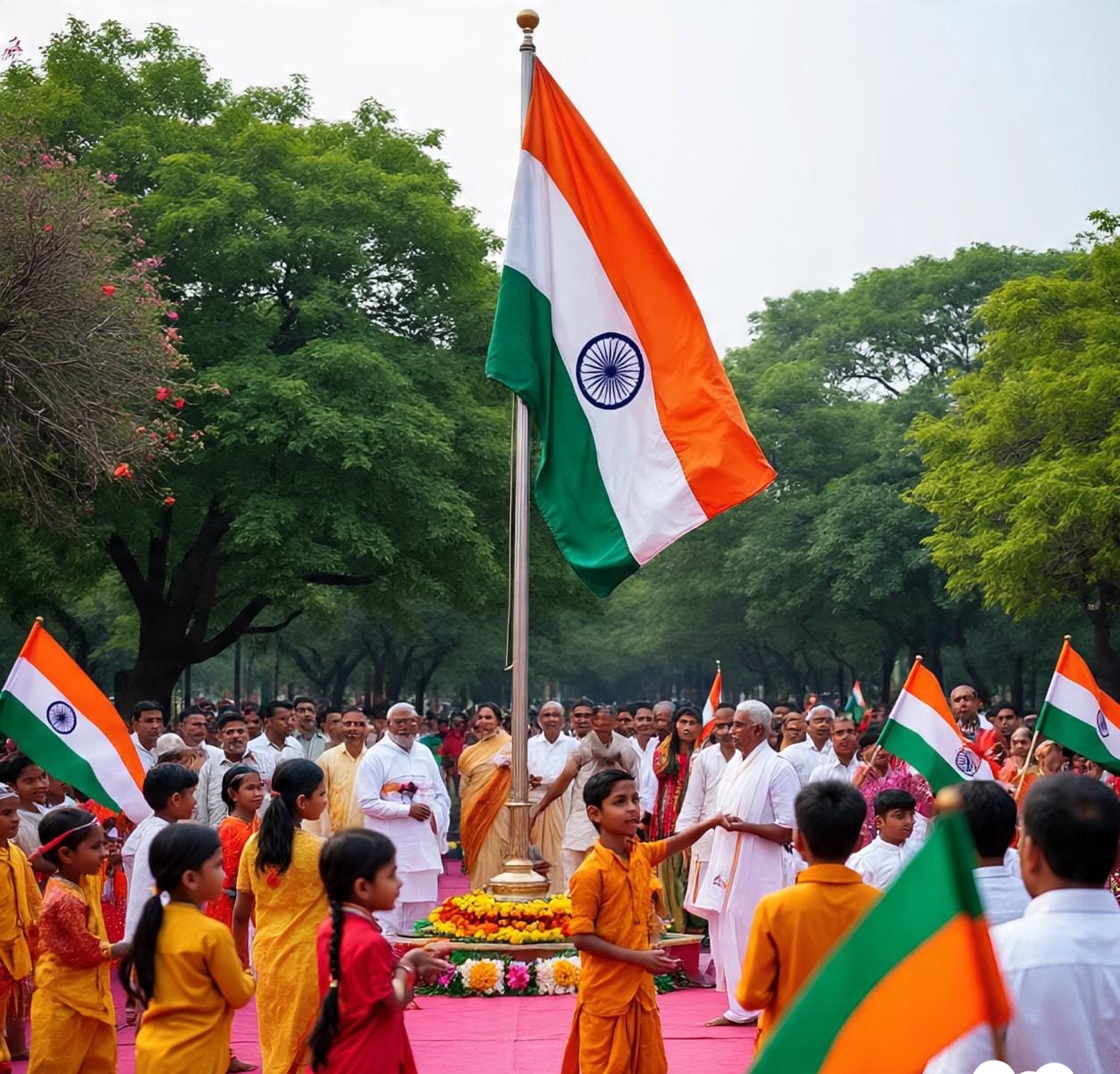
India at 77: A Symphony of Sovereignty and Strength
The Definitive Guide to the 2026 Republic Day Celebrations
Date: January 26, 2026
Location: Kartavya Path, New Delhi
Mood: Electric, Patriotic, and Future-Ready
The winter mist over New Delhi lifted early this Monday morning, revealing a sight that stirs the soul of every Indian: the tricolour unfurling against the pale blue sky, showered by rose petals from thundering helicopters. Today, January 26, 2026, India does not just mark a date on the calendar; it celebrates a milestone. As the nation observes its 77th Republic Day, the atmosphere at Kartavya Path is not just one of ceremonial tradition, but of a bold, confident assertiveness.
Seventy-six years ago, we gave ourselves a Constitution. Today, we showed the world what we have built with it. From the historic echoes of Vande Mataram to the futuristic hum of drone swarms, the 2026 parade was a masterclass in balancing civilizational heritage with cutting-edge modernity.
Here is your complete, immersive chronicle of the 77th Republic Day celebrations.
1. The Theme: “150 Years of Vande Mataram”
If 2025 was about looking back at 75 years of the Republic, 2026 is about the spiritual fuel that got us here. The central theme of this year’s celebration is “150 Years of Vande Mataram.”
Bankim Chandra Chattopadhyay’s immortal song, penned in 1876, became the battle cry of the freedom struggle. This year, the government wove this legacy into the very fabric of the parade.
Visual Tribute: As the parade commenced, the manicured lawns of Kartavya Path were lined with “view-cutters”—special installations featuring the 1923 paintings by artist Tejendra Kumar Mitra, which illustrate the verses of the song.
The Narrative: The Ministry of Culture’s tableau did not just play the song; it visually narrated its journey from a poem in Anandamath to the mantra that rattled the British Empire.
A Living Anthem: The parade didn’t just feature military marches; it moved to the rhythm of this hymn. The underlying message was clear: India’s modern aspirations are rooted in its ancient resolve.
2. Diplomacy on the Dais: The European Connection
In a significant diplomatic first, the guest box at Kartavya Path hosted not one, but two Chiefs of State from the European Union, signalling a massive geopolitical shift.
The Guests: Mr. Antonio Costa, President of the European Council, and Ms. Ursula von der Leyen, President of the European Commission.
The Significance: Their joint presence underscores the deepening strategic partnership between India and the EU, particularly in trade, clean energy, and defence. Mr. Costa, with his Portuguese-Indian roots (Goan ancestry), added a personal touch to the diplomatic grandeur.
As the President of India, Smt. Droupadi Murmu, arrived in the traditional buggy, flanked by the President’s Bodyguard (PBG), the sight of European leaders standing in salute to the Indian Tricolour was a potent symbol of India’s rising stature in the Global South and the West alike.
3. The Parade: A New “Battle Array”
For decades, the Republic Day parade followed a standard template: marching contingents first, followed by mechanised columns. 2026 shattered this mould.
For the first time, the Indian Army displayed a “Phased Battle Array Formation.”
Instead of isolated units, the parade showcased how the military actually fights. It was a combat sequence brought to life on tarmac.
The Sequence: It began with reconnaissance units (scouts), followed immediately by the “spearhead” of tanks and infantry combat vehicles, and supported by artillery and air defence systems. It was a raw, kinetic display of the “Combined Arms” doctrine.
Operation Sindoor: The parade featured a dedicated narrative around “Operation Sindoor,” showcasing the integration of intelligence, surveillance, and strike capabilities. A glass-cased “Integrated Operational Centre” rolled down the path, giving civilians a rare glimpse into the nerve centre of modern warfare.
The New Guardians: Debutants of 2026
The roar of the crowd was loudest for the new faces of the Indian defence establishment:
The Bhairav Light Commando Battalion: A newly raised unit, marching with a distinctive, rapid pace, symbolising India’s focus on agile, special-operations-capable infantry.
The Shaktiban Regiment: This was the showstopper. Part of the artillery arm, this regiment doesn’t carry guns; it carries drones and loitering munitions. Seeing soldiers marching with tactical UAVs and “suicide drone” launchers strapped to their gear was a stark reminder that the future of war is unmanned.
Robotic Mules: In a nod to high-altitude logistics, the Army displayed the “Him-Veer” robotic dogs—quadrupedal robots designed to carry loads in the Himalayas where even mules struggle.
4. Indigenous Might: Aatmanirbhar Bharat in Action
The days of displaying imported Soviet or Western gear are fading. The 77th Republic Day was a showcase of “Made in India.”
Armour: The Arjun Mk-1A Main Battle Tank and the T-90 Bhishma (indigenously assembled) led the charge.
Missiles: The Nag Missile System (Tracked) Mk-2 and the terrifying BrahMos mobile launchers rolled by, representing India’s ability to strike land and sea targets with pinpoint accuracy.
Air Defence: The Akash and MRSAM (Medium Range Surface to Air Missile) systems displayed the invisible shield that protects Indian skies.
DRDO’s Showpiece: The Defence Research and Development Organisation unveiled the Long Range Anti-Ship Hypersonic Missile (LR-AShM). Though a static display, the implication of a hypersonic glide vehicle capable of engaging moving targets at sea sent a ripple of awe through the defence attachés present.
5. Cultural Kaleidoscope: The Tableaux
Thirty tableaux—17 from States/UTs and 13 from Ministries—rolled down the path, painting a picture of a diverse yet unified nation.
Themes: The twin themes were “Swatantrata ka Mantra: Vande Mataram” (Mantra of Freedom) and “Samriddhi ka Mantra: Aatmanirbhar Bharat” (Mantra of Prosperity).
Uttar Pradesh: Showcased the spiritual tourism circuit, blending the ancient ghats of Varanasi with the new infrastructure of Ayodhya.
Karnataka: Highlighted its dual identity as the cradle of Hoysala architecture and the silicon capital of India, featuring a tableau that morphed from a stone temple to a semiconductor chip.
Jammu & Kashmir: Focused on “Purple Revolution” (Lavender cultivation), moving away from conflict narratives to stories of agricultural prosperity.
The Veterans’ Tableau: Titled “Sangram se Rashtranirman Tak” (From Struggle to Nation Building), this emotional float depicted veterans not just as former soldiers, but as active contributors to civil society.
6. Nari Shakti: Women at the Forefront
2026 continued the tradition of highlighting women’s power.
BSF Camel Contingent: The famous BSF Camel band, once an all-male bastion, was led by women officers, their ceremonial uniforms resplendent in the winter sun.
Daredevils: The motorcycle display by the “Seema Bhawani” (BSF women bikers) drew gasps as they performed the “Human Pyramid” and “Peacock” formations on moving Royal Enfields.
7. The Grand Finale: The Flypast
As the clocks ticked towards noon, all eyes turned upward. The Air Force flypast is always the climax, but this year, the choreography was split into two distinct blocks for better visibility.
The “Sindoor” Formation: In a direct nod to the parade’s operational theme, a mixed formation of Rafale, Su-30 MKI, and MiG-29s roared overhead, simulating an air dominance package.
The “Trishul” Maneuver: Three Su-30 MKIs pulled up vertically into the sky, dispensing flares that pierced the smog, creating a trident shape in the heavens.
The Vintage Link: The “Dakota” heritage aircraft flew alongside the modern C-295 transport plane, bridging 75 years of aviation history.
Conclusion: The Road to 2047
As the National Anthem played and the President’s Bodyguard escorted the President and the Chief Guests back to Rashtrapati Bhavan, one feeling lingered: Confidence.
The 77th Republic Day was not just a parade; it was a status report. It told the story of a nation that honours its 150-year-old songs while building hypersonic missiles. It showed a country that invites global superpowers as guests but relies on its own factories for defence.
As we march toward the centenary in 2047, the 77th Republic Day will be remembered as the year India stopped just “emerging” and started “arriving.”
Jai Hind!